I meet with new teachers weekly to discuss teaching strategies, tips, and lesson planning. Frequently the topic of teaching slope is discussed since this is a rich content area for teachers, a vital skill for students and often the subject of many frustrations for teachers and students alike.
Why Teaching Slope is Crucial
Slope forms the basis for writing equations and graphing. Without an understanding of what it is and how to calculate it, the rest of the semester (and year) becomes much more difficult for students and teachers. Even though the district pacing allows two days (what are they thinking????) for learning slope, students need much more than this to truly understand the calculation part of it.

Why Students Find Difficulty
Why do students have such a difficult time? In my experience, they automatically distrust anything that resembles a fraction. The slope formula looks like a fraction. I describe it to students as a ratio, a proportion, a shorthand for two calculations—I do not use the f-word. If I do, I have lost students already. Slope, as difficult as it is for students, is actually an activity-rich content for teachers. There are a multitude of ways of teaching and reaching students that will appeal to a variety of different learning modalities.
What is slope video I sometimes use a video as part of my warm-up (also called bell ringers, do-nows) process at the beginning of each period. When I show a video, I also include a quick write. In this case, I might ask students to tell me what they know about the slope. Then I show the video and ask them to update what they know about slope now. This is a great assessment to know what your students remember as well as being a way to activate their prior learning.
In our curriculum, the unit with slope follows the unit on Arithmetic Sequences. We have noticed patterns, written rules, found terms and completed tables for terms. The next step in my classroom, because it follows logically, is to find slope from tables.
Slope from Tables Video This is the way I teach students to use tables to find slope. I avoid using the formula until my students are familiar with the “fraction” of slope.
Activities for Teaching Slope
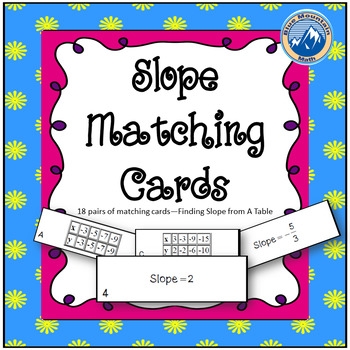
Slope from Tables Matching Card Activity I use this activity of matching cards to have students make posters. Whenever I use a new activity in class, I always do the first one or two with students so they understand the process I use. They may think differently, and that is fine, but I give students a framework to complete work if they need one. Matching cards are great for differentiating, you place students in pairs (or small groups) and just use part of the cards. You can have them show their thinking right on the poster.
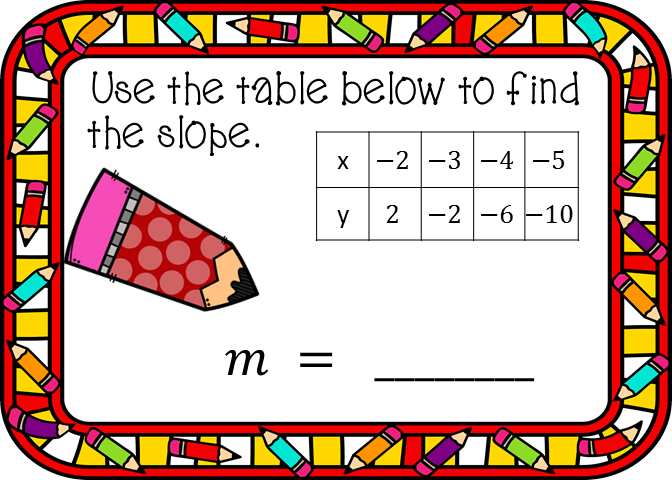
Slope From Tables Boom Cards If you have devices in your classroom (iPad, Chrome Books, Laptops, etc), using online practice with instant feedback makes life easier. These 40 cards usually take the average student 20 minutes to practice and can be used at home for homework. More about Boom CardsTM here.
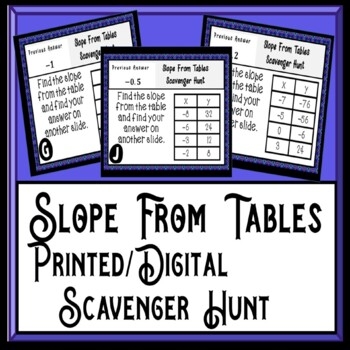
Slope from Tables Scavenger Hunt This is both a digital and paper activity that can be used in the classroom in groups. Use the digital version for students to practice at home or for absent students. Students start, solve the problem and look for the answer on another page. It is a self-checking activity so students know if they are correct.
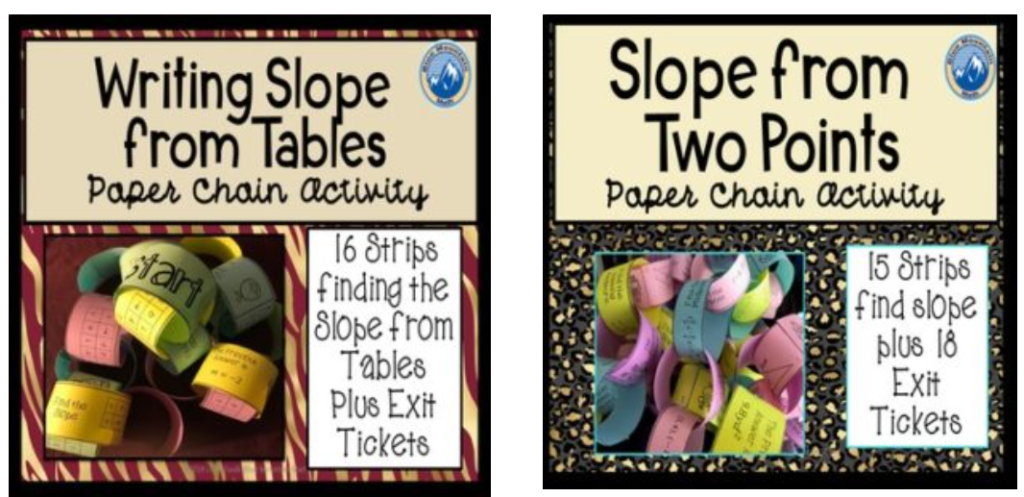
Slope from Tables Paper Chain Activity Every Friday I do something that is a review but a little more fun. Paper Chains are very popular in my classroom. Students work in pairs to solve the 16 problems, find the answer on another strip, and repeat until all strips are placed in order. Then they attach them in order, turn in their work on paper. It also makes a colorful display in your room.
Slope Dude Video This is always a hit with students, I usually show it several times. It is short and memorable.
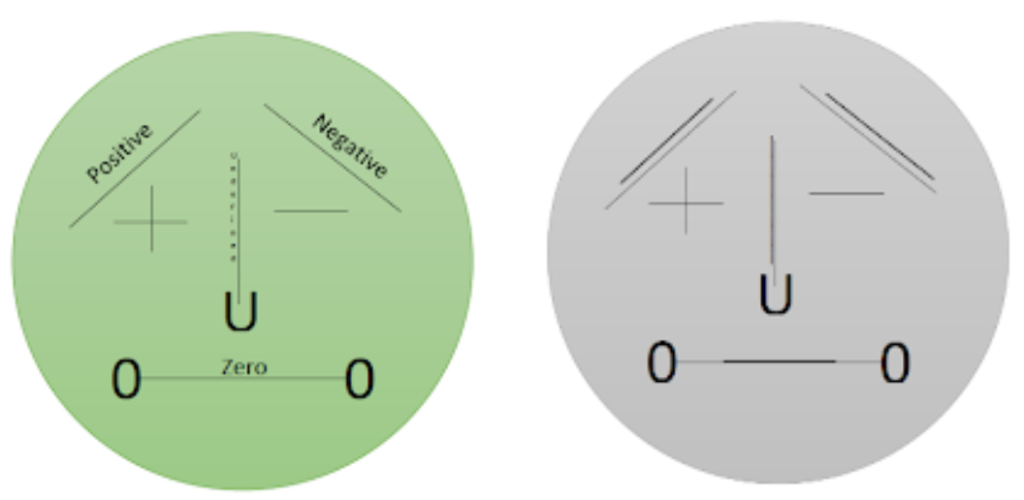
Slope Man Poster, Notebook Copy This is the poster I use to introduce slope man, a graphic that helps students (and me, I confess, I can’t remember zero and undefined slope without thinking) remember positive, negative, zero and undefined slope. There is a colored page, a greyscale page and a page I use for students to place in their interactive notebook. I have the students fill in their graphic as I do mine, and then place my poster for review the next day.

Shodor Slope Slider Sometimes students need to see and play with a line to see the connection between slope and the slant of the line. This is a great free activity.
Desmos Slope Activity Desmos, a free graphing resource for teachers and students, has some wonderful activities for slope. This particular activity is a good starting point for developing language about the steepness of a line. And the student answers can be viewed by the teacher and shared with the class (no names involved) so it makes a great class discussion.
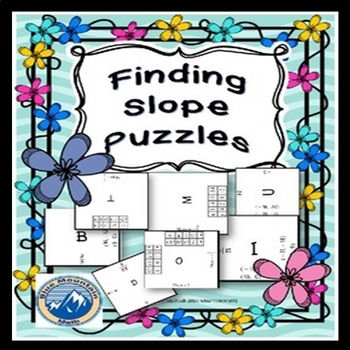
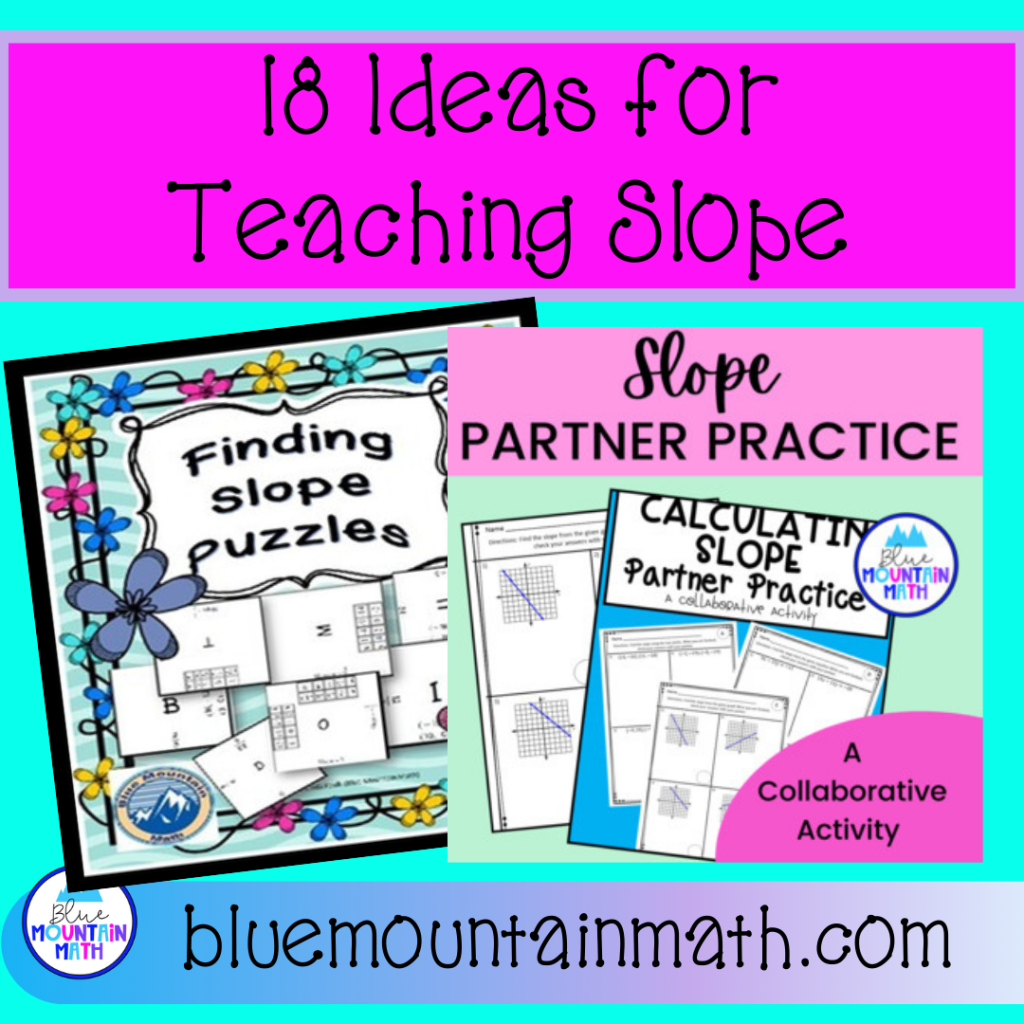
Slope Puzzles If you are looking for a fun Friday activity, bring out the puzzles. This has 4 different puzzles with two different levels of difficulty. Two of the puzzles use tables, the other two use two points.
Slope of a Line Slider Once I have introduced the formula for slope, this visual slider will help students make the connection between the slope as graphed and the formula shown. Students just adjust the slider to see the change in the formula.
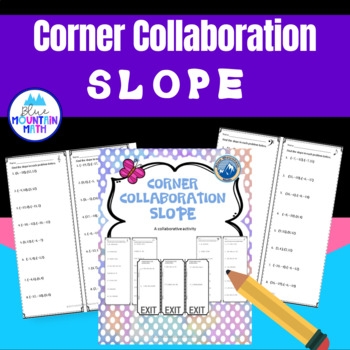
Corner Collaboration If you are trying to get students working together and talking (talking about math), this is an activity that works with all levels of students. There are 4 different versions of problems, students in groups of 4 will work on their individual problems while discussing the steps for solving with their group. When some time has passed, students move to the corners to discuss their answers with students who have the same version as they do. When time is up, they return to their home group to compare methods.

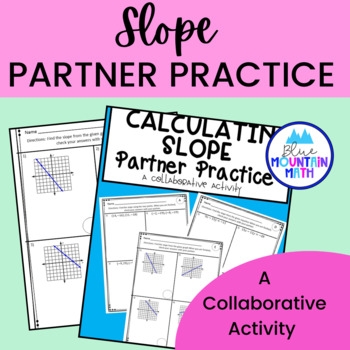
Partner Practice This is an activity for a pair of students– if you have an odd number of students one trio works as well. Students have different versions of problems with the same answers. They complete each problem and check with their partner to see if their answers match. If they do, success. If not, they need to discover their mistake. My students work very hard to be right when doing this activity.
Slope from Two Points 3 of a Kind
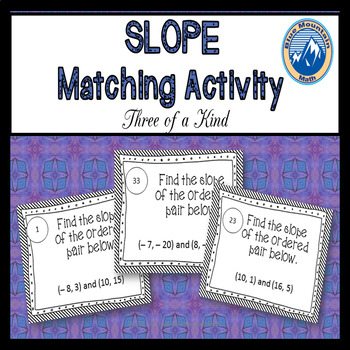
This is a matching card activity where students have 3 cards with the same answers. Works well with small groups. I ask students at the end of the period to do a quick write on what was the most difficult problem for the group and how they arrived at an answer. With this activity, there are exit cards for a quick assessment or the exit cards can be used for the next day for a review at the beginning of the period.
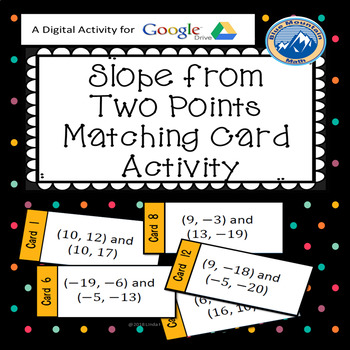
Digital Matching Card Activity
This is a matching card activity that uses Google Slides for an easy online activity in the classroom. Easy to assign through Google Classroom and since it can be accessed at home, it is a good homework or review option.
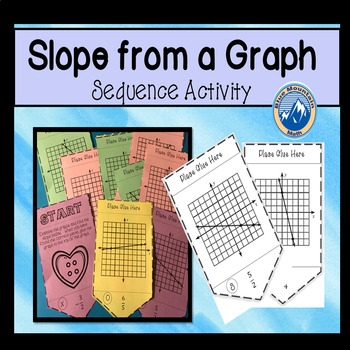
Slope Sequence Activity I love activities where students need to find the pattern and connect the pieces. This is a great beginning activity for students because it has few pieces and is self-checking. Teacher prints on colored paper and cuts out the sets for students (never have students cut out, it will take days, lol). Students can complete for a quick review or practice.
Some teachers tell me they use this at the beginning of the unit with success, but I always use it at the end. It is my transition to graphing linear equations in slope-intercept form. Some students are just confused about graphing and where to start. Once they are comfortable with identifying slope from a graph, I use that to show students how they can graph an entire line using slope only.
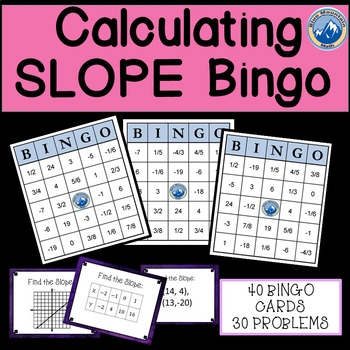
Who doesn’t love Bingo? Students love it and it makes any content fun. The first time I used it in the classroom I Assumed that all students understood how to play but I was wrong. 2 students were busy solving problems and crossing off all the squares on their card, oblivious that they already had a couple of winning bingo lines. Now I explain the rules of any game that I use in the classroom.
I would love to hear about activities you are using in the classroom to teach slope. You can leave a comment or email me at bluemountainmath@gmail.com. I am always looking for ideas to help students be successful.
Leave a Reply